
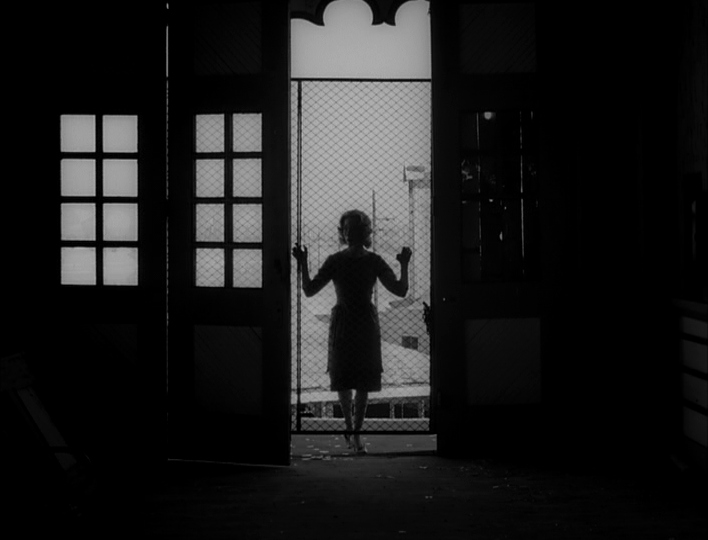
Carnival Of Souls is a hypnotic treat to digest. It was an overlooked film back in 1962 but its foreboding beauty seems to generate a long lasting impression for many cinephiles. It’s very iconic and special, considering it inspired George A Romero’s Night of the Living Dead in 1968. Despite its low budget, minimal locations, small cast, it achieves a vision of mystery, darkness and horror, and it transcends its essence into what makes one want to become a filmmaker.
As the story goes, Mary, played by Candace Hilligoss is a bit of a lost soul. She walks away from a car accident and moves onto a job in Salt Lake City as an organist for a church. She drives through the night, and at one point all she hears from her car radio is organ music. There’s also a moment where she sees the startling image of a creepy dead man in the reflection of the car window, which startles her so much she swerves off the road. Luckily no catastrophic accident. She’s able to get back on the road and continue on but while heading to her destination notices out into the distance of the salt bed there’s a great pavillion, and not knowing what it is, she’s transfixed by it. Eventually Mary arrives at a boarding house run by Mrs. Thomas, which is a rather awkward interaction given Mrs. Thomas keeps reiterating about how she’s allowed to take many baths.

The next morning, Mary arrives at the church to start her job.The minister feeds into her curiosity and drives her out to the great pavilion, which was once a great dance hall and amusement park that was abandoned. Mary wants to go in but the minister says, “no” as it’s against the law to trespass, which I think is kind of funny as it nearly alludes to a dividing line of sorts between right and wrong, darkness and light, etc. There’s a strange dichotomy here that foreshadows what will eventually be revealed in the end.
I had my suspicions early on about Mary, and given those suspicions it was gratifying to watch what the filmmaker Herk Harvey, who also plays the ghoulish “Man” does throughout the film with his leading star. For instance in the shopping mall, Mary wants to purchase a dress and is ignored or when she goes to the train station attempting to buy a ticket but is again ignored. She can’t really participate in choices that will indicate vitality. However in certain interactions she has with the doctor, the minister, John Linden, and Mrs. Thomas indicate otherwise, which brings this whole world into question of reality. What is real and what isn’t?
The most prominent line given by Mary is when she says, “I don’t belong in the world. Something separates me from other people.” It’s a monumental notion to feel out of sync with the world, and there’s a vehement frustration that lingers within Mary. She’s searching for answers as we all often do, wandering aimlessly until she reaches a particular moment of clarity, which becomes life altering. It’s challenging to test the rules of this world as certain aspects don’t necessarily fit into the context of reality. So there are things I find conflicting and I don’t have answers to. Therein lies the frustrations cinema often presents, there are no specific explanations just an experience that washes over you and that’s fine. I think it is where art filmmaking really finds its strength, allowing its audience to draw its own conclusions. So with that here is your spoiler warning if you haven’t seen the film. Skip the rest of this paragraph. Mary is clearly deceased and the entire film is perhaps what happens when the soul departs the body. The fabric of reality feels like it’s still intact but it’s not. Her sense of reality is beginning to decay and we see this when Mary sees the dead or when she’s ignored. There’s a foreboding vibe at the center, electrifying what’s left of Mary, who’s slowly fading away even in this fragile blink of a moment the idea of time is stretched in a way that feels impossible to comprehend. Ah the mystery thickens.
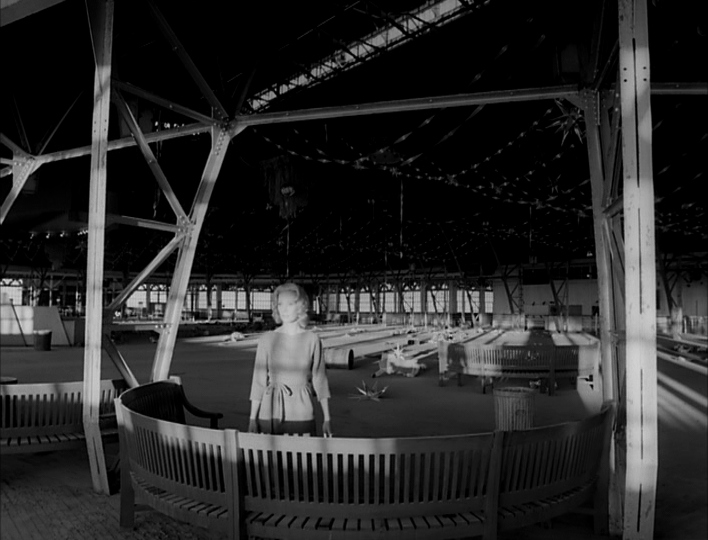
Spoilers aside, a pertinent staple of Carnival of Souls is the alluring imagery of an abandoned amusement park in the middle of the salt lake which has disappeared, a very fitting milieu. The iconic imagery of spooky dead people rising out of the water certainly reminds me of the moment in Freaks, where they come out from under the wagon and mud in the pouring rain chasing out the main star and I love this connection even if it’s from 1932. I wonder if Herk Harvey was inspired by Freaks in some way or another. I imagine he had to have seen it at some point in his life.
Even though Carnival Of Souls, faired poorly at the boxoffice, it remains a cult classic which is an extraordinary feat. It’s a visually stimulating, low budget, genuine ghost story set in a small American town, that has a purity to1960s nature. It was a time and a place that will never exist again except on celluloid.
 MARISSA THE CINEPHILE
Leave a comment