
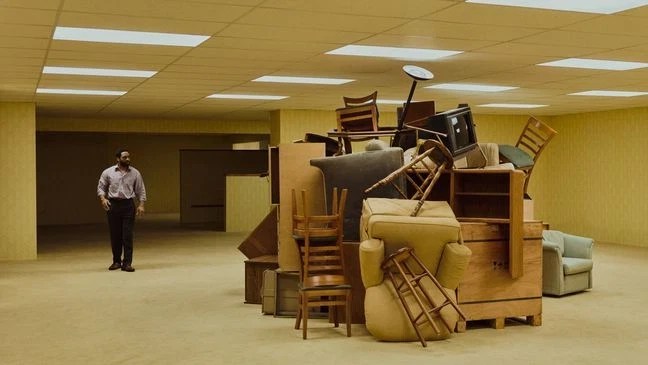
I’m going to try and describe this film to you as if you’ve never seen a dog before. Yellow-stained wallpaper fills the empty spaces with displaced, deformed furniture, while footsteps lurk and things replicate with sighful dread. Nothing makes sense and yet it is everything you can imagine and more.
As a maturing millennial, I’m pretty selective when it comes to watching films for purely entertaining purposes these days, because when you get to a certain decade of your life, time becomes a nonrenewable commodity. This of course is my attempt at dry humor. The experience of taking the time to go to the theater to properly watch a film I’m genuinely interested in was not a loss. I jumped in fright, my body tensed up, and I laughed. Compliments to the filmmaker, I was entertained.
Anywho, some may say the film industry is in a state of decline, others might disagree and say it’s undergoing a transitional period to which it certainly does feel like we’re falling off the precipice into some kind of change (so a healthy bit of trepidation is in order). With my healthy trepidation, I believe both sides are true, but I also believe the emergence of YouTube-born filmmakers are having a moment. With all this change in process, I was very unnerved by Kane Parsons’ film Backrooms. This 20 year old kid from Petaluma, California has an edge, and A24 the little disrupter company that it is, won the bid to turn what was originally a webseries of the same title into a feature length film. I would say the gamble paid off given the budget was $10 million, and it’s already grossed $221 million. Not bad at all for a science-fiction horror film.
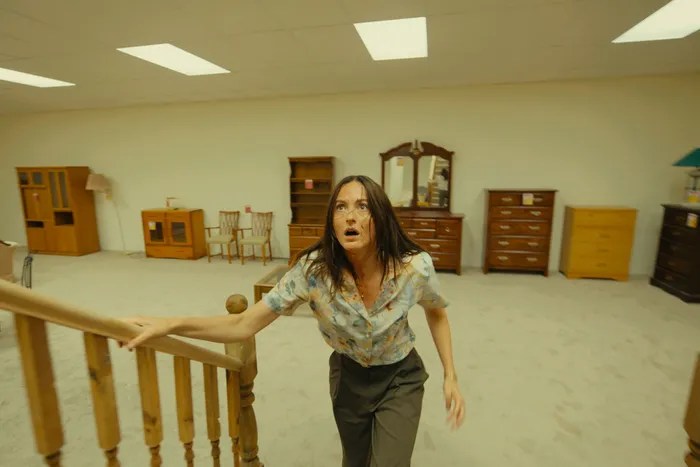
The basic lay of the land in Backrooms is furniture store owner, Clark (Chiwetel Ejiofor) is sorta just drifting in life as a failed architect, probably divorced and definitely an alcoholic is working at a store he has zero interest in until he just loses his mind when the circuit breaker keeps breaking. While trying to fix the circuit breaker, he hears noises and discovers the backrooms, an extradimensional space that just exists, but things aren’t what they seem (they never are). The secondary character, Mary (Renate Reinsve) is Clark’s therapist, who also appears to be carrying some heavy trauma. We see flashbacks of her childhood living with a mentally ill mother, who was institutionalized. Mary’s own mental tumbling block is her deep-rooted anxiety. The other two characters Kat (Lukita Maxwell) and her boyfriend Bobby (Finn Bennett) both work at Clark’s furniture store, who also get pulled into the Backrooms at Clark’s insistence as “research”. Let’s just say things don’t go so well. Eventually Mary goes searching for Clark, and she finds him albeit terrified at everything this new world has to offer.
The scariest portion of Backrooms aside from the liminal space and the feeling of being trapped, is the third act where Mary is tied up sitting at a kitchen table with Clark and three other deformed replications of former humans. Mary tells Clark she can’t help him and all his problems stem from his whining and inability to take zero accountability for himself. I think in therapy they call that a moment of clarity or a breakthrough? Either way, the truth had to be blurted out, because Clark really isn’t a great guy and instead of confronting that hard truth he admits to being happy in the backrooms, full on embracing the feeling of nothingness is comforting to him. Whoa! That’s a heavy hell. I don’t want to spoil the next bit nor the ending, but all I’m going to say is there’s a pirate and his name is Captain Clark.
So what makes Backrooms work, without noting the stylistic influences of some Lynchian flair or a kind of Salvador Dali-esque painting? The crux of the story in one sense is an AI nightmare, constructed as a cautionary tale about getting lost in a labyrinth and turning into sloppy sauce. I have to admit the AI thing didn’t quite take root in my brain as I was experiencing the film, but in a post conversation with my boyfriend and more processing later, a lightbulb went off. I think Backrooms represent a kind of hall of mirrors, given the mental states of Clark and Mary. We learn, Clark finds comfort in the backrooms, and really it’s a manifestation of his life in fragments. Memories that aren’t quite aligning to what was versus what is, and ultimately becomes a distorted loop of his life. When Mary is in the Backrooms, she no longer is a performative therapist, instead confronts confrontation head on, by calling out Clark on his bullshit. In a way this was like a release valve of the repressed trauma she’d endured her entire life which seemed to have kept her in a nonconfrontational loop. In many ways, these two characters are polar opposites. The yin and the yang to which they both help each other in a destructive but also constructive way given their outcomes are entirely different.
Now I can loosely see the foreboding AI as a kind of skeletal structure threaded into this nightmare of a story in that the thing that takes away your humanity is a frightening thing, because humanity is all we have, and if we don’t have that, who are we? I saw Backrooms not necessarily as a metaphor for AI, but an interpretation of how brains work and if you marry AI and the brain together there’s a sort of semblance that’s hard to parse. I also feel like it portrays visually what the internet feels like; a lost labyrinth of sorts. Both apparatuses retain information and like a memory, details diminish over time, both due to faulty hardware and wear and tear on the human body. It’s terrifying how we can be so connected yet the biggest disconnect is our human emotions, our human soul. There were numerous times throughout watching Backrooms that I jumped and reflecting afterwards I thought would an AI machine react the same way? If AI feels no fear and I jump at a loud noise or get startled by a scene, it affects all these other intricate systems that keep me alive; blood pressure, oxygen, heart rate, hormonal balance, etc. AI may understand those systems better than me but it will never experience those things.
I’ll end with a headline from Variety from Kane Parsons himself, “ AI defeats the purpose of filmmaking.” I can’t applaud louder. 5 stars for this film! Parsons seems like he’s going to be one of the good ones.


Leave a Reply